
Meetup Summary: Model Context Protocol (MCP) Panel Discussion
On August 20, 2025, Solution Street hosted a lively panel discussion as part of the Software Architecture Roundtable Meetup series, diving into one of the most exciting developments in AI integration: the Model Context Protocol (MCP). Moderated by Greg Hodum (Managing Director, Solution Street), the panel featured:
- Neil Chaudri (President, Vidya LLC): AI, cloud, and security expert.
- Soujanya Vullam: Software engineer specializing in scalable cloud-native solutions.
- Pervez Choudhry (CEO, Gentro): Leading an MCP platform company with deep enterprise experience.
The evening mixed live demos, technical insights, and spirited discussions around what MCP means for developers, enterprises, and the future of AI agents.
What Is MCP?
Greg kicked off the discussion by first doing a quick introduction of MCP for those less familiar with it. He described MCP as the “USB-C of LLMs” – a universal connector for AI models. The benefits of MCP include:
- Standard protocol that allows LLMs to plug into external tools, APIs, and data.
- Solves the M×N integration problem by providing a consistent interface instead of bespoke connections.
- Ecosystem growth has been rapid: from its design in 2024 by Anthropic to OpenAI’s adoption in 2025, MCP now boasts thousands of servers and dozens of clients.
Greg demonstrated MCP in action using Claude Desktop:
- Without MCP, the LLM couldn’t answer a real-time weather query.
- With an MCP server enabled, Claude fetched live weather data via JSON and delivered a natural language response.
The demo made clear how MCP transforms LLMs from static chatbots into actionable, tool-using agents.
Model Context Protocol Architecture
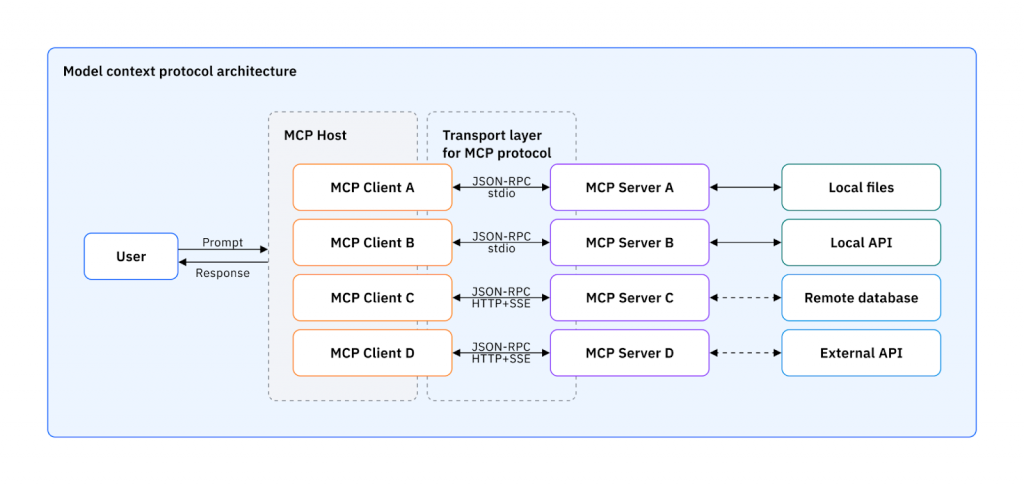
Neil gave a brief explanation of the typical architecture of systems built using MCP, which involves hosts (like Claude desktop or IDEs), clients (within the host), servers (exposing function calls), and backends (doing the actual work, e.g., a weather app). It’s a multi-tiered client-server architecture, and developers’ new role is building and testing these MCP servers and tools. Beyond tools (like API calls for actions), MCP also uses “resources” (for fetching data) and “prompts” (for tasks like code generation, acting as templates).
Panel Insights
Defining MCP
Neil kicked off the discussion by stating that “MCP makes AI agents not just possible, but realistic, by simplifying and standardizing how they connect to tools.” Soujanya compared MCP’s role to HTTPS for the web – a standard that unlocks broad adoption. Pervez described MCP as an abstraction that lets agents call APIs through natural language instead of code.
Real-World Use Cases
The panelists showcased how MCP is already being applied:
- Developer Productivity – Soujanya described how she was automating AWS Lambda deployments directly from Cursor IDE; local document summarization with Claude Desktop.
- Business Process Automation – Pervez talked about building a Slack agent triaging support requests and creating Jira tickets for a music marketplace startup.
- Everyday Tools – Neil listed tools that are available today: AI-assisted coding (Cursor, Warp), querying GitHub repos (Context7), automating design workflows (Figma, Playwright), and more.
Challenges & Risks
While enthusiasm was high, the panel acknowledged MCP is still maturing.
- Security, Privacy, and Trust: MCP itself doesn’t mandate extensive security measures, but it’s crucial to apply traditional software best practices (authentication, authorization, transport security, sandbox isolation, data protection/redaction) to MCP implementations. Existing security infrastructure should be integrated.
- Performance: Some servers are slow or prone to timeouts and too many active servers can bog down clients.
- Token costs: Heavy orchestration burns through LLM usage, and the token costs can add up!
As Neil noted: “MCP won’t save you. The same software best practices we’ve relied on for decades matter even more now.”
Is MCP Ready for Prime Time?
The consensus was cautious optimism:
- MCP is already boosting productivity and simplifying integration.
- Organizations are using it in lower environments today, with production adoption on the horizon.
- The developer’s role is shifting – from writing custom API connectors to building and maintaining MCP servers.
The panel discussion was followed up by a spirited Q&A, where the panel discussed the need for an MCP Gateway, testing non-deterministic systems and improving determinism of the APIs that are connecting to LLMs using MCP.
Key Takeaways
Some of the key takeaways from the discussion were that MCP is rapidly becoming the standard for AI-to-tool integration. It’s still early, but the ecosystem is growing at remarkable speed, and security and trust must be treated as first-class concerns. Now is the time to experiment with MCP; build small agents, wrap internal APIs, and learn the orchestration patterns.
The Bottom Line: Just as HTTP and REST standardized the web, MCP is poised to standardize how LLMs interact with the digital world. The future of AI agents is here – and it’s powered by MCP.
Solution Street was happy to host the MCP Panel discussion – it was an informative and engaging event, while also sparking meaningful connections within the local tech community. We’re excited to continue hosting more technology meetups in the future, and we encourage you to join the NOVA Software Architecture Roundtable group to stay updated on upcoming opportunities. At Solution Street, we specialize in AI/ML and have built a tailored approach to help clients overcome internal challenges and maximize the value of AI. If you’d like to learn more about how Solution Street can support your organization in navigating the fast-evolving world of AI, we’d love to connect!